

Posted on November 12, 2015
‘Social Entrepreneur versus Leadership via Service Design’
Over the last 30 years most researchers have been converging on leadership, as Petriglieri (2014) states, “as the exercise of influence, as an activity, as something that the leader does to others. We haven’t paid enough attention to leading as something that the leader does on behalf of others.” The reflection on this belief has brought up only one side of the leadership relationship, from the leader to the follower, and we have been much less aware of the other side – from the follower to the leader.
In the leadership development theory the tendency is to design with the implicit goal in mind for homogeneous organisations. The actual business landscape shows that organisations are very different – they are precarious as well as very personal. Consequently, the leadership development needs to put on hold the silver bullet of rising up and distinguishing yourself. A new stance towards a different goal would keep people connected to themselves and others. The two connections that we need are a shared purpose and a direction to emerge. (Petriglieri, G. 2014)
Contemporary leaders like Mark Zuckerberg and Richard Branson are often depicted as charismatic business leaders. The first is considered as a genius able to keep his teams effective to bring Facebook forward. Branson with his unconventional attitude embodies a forward-looking vision to create something different in several industries. Such leaders propel great influence on their followers. They enliven people to act in certain ways with their enthusiasm, self-confidence and pure engagement in their business (Dawnson and Andriopoulus, 2014).
Several leadership researchers are looking beyond the concept of charisma and focusing on the idea of what they mean by ‘visionary leadership’. Robbins and Coulter (2002) argue that ‘visionary leaders create and articulate a realistic, credible, and attractive vision of the future that improves the present situation’.
In other words, it is about visions that revolutionise that way we think about business as much as transform people’s lives. Steve Jobs of Apple, Jeff Besoz of Amazon and Micheal Dell of Dell Computers are leading examples of leaders with clear and compelling visions that inspire and muster energy across their organisations.
What would leaders need to employ to act more like designers?
Three words: empathy, invention and iteration.
Four basic questions to map out the design process:
What is investigate the present;
What if envisions a potential future;
What vows makes some choices;
What works is guide into the actual marketplace.
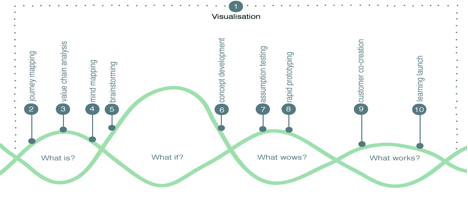
Convergent and divergent thinking unfold by expanding the bands around each questions. There are ten tools that a design leader can use to address the four questions. At Procter & Gamble product developers spent a long time figuring out what the customers actually wanted. Design Thinking helped – instead of focusing on the detergents, they produced a better mop, the Swiffer. For the leader or manager, a positive conflict between shedding light on the unknown and protecting the best of the present is the way to go forward to reach new innovative models (Ogilvie and Liedtka, 2013).
By unlocking an individual creative potential it could spur a positive impact on the world. To embrace innovation at scale, leadership and grassroots need to blend to feed a collaborative culture. Mauro Porcini, the Chief Design Officer at PepsiCo, argues to gain creative confidence by framing five phases in corporations. ‘We are not creative‘: executive and employees say. This is the first phase with a reluctant attitude. The second phase is called ‘hidden rejection‘. Executive support fails to move from word to action. Mauro sees the third phase as ‘leap of faith‘ where higher roles show a clear initiative to invest resources that allow others to take risks and share their abilities, even if they fail. The fourth phase is ‘quest for confidence‘. Here the organisation enhances the creative resources in helping to achieve goals. Mauro calls the fifth ‘holistic awareness and integration‘. In this stage, teams regularly use creative tools to the challenge they face. The creative confidence is embedded in the company‘s DNA (Kelley, T. 2013).
These approaches shift the focus to humans rather than organisations. Therefore the understanding of value and the nature of relations between people and other people, between organisations of different kinds, are now considered as core to designing service. Service Design is playing a decisive role in drifting previous perceptions, by crafting boundaries around notions of creativity, pro-actively illustrating the meaningful social application of design, and connecting more people in the design process (Andrews, K. 2011).
If I let this crossing-view leapfrog toward the social entrepreneur profile, we see three pivotal tensions – Roger Martin and Sally Osberg outlined them beautifully in his or her endeavours:
Abhorrence and Appreciation
Expertise and Apprenticeship
Experimentation and Commitment
I want to share these ideas as I strongly believe in a positive shift as daily creative commitment in individuals who are the heart of any sort of organization.
Posted on November 9, 2015
What if…Fifa would turn officially in a Social Entreprise?
What if…Fifa would turn officially in a Social Enterprise?
Bad tangle, it is a very thick and itchy tangle. FIFA debris are all over the place. Billions of customers are waiting and there are a plane missing because there is no runaway. On top of that it is daunting to acknowledge that anybody has a firm grip on the issue. In the close-up the organisation status says no-profit. Where is the sense-making? Why do we need FIFA to exacerbate the connection with this sport? If the world’ fans need FIFA, what is the impact ?
Given the actual shamble the organisation is going through, the thread we hear the most is to turn Fifa organisation upside-down. Yes, the main sponsors urge Blatter to resign as they need to save their business and social responsibility identity, although it would be highly arguable. Fifa President Sepp Blatter, Secretary General Jerome Valcke and Uefa President Michel Platini have all been put away from football by Fifa’s Ethics Committee for 90 days. If we look at the future the horizon struggles to filter out the dirty management of the next two world cup at least. Media and web search engine seem to be in the same sort of sound as I seek for different way to address this problem.
Being aware of the high level of complexity and again, the system destorys you, I wonder how I could envision a new FIFA. Here it is, happily, a glimpse of hope shows up in my research. There might be a bottom-up drive to scope the problem notwithstanding, I still call for a different thinking.
What is the status quo?
Hierarchy along with hidden agenda, lack of transparency, uncertainty and ineffective leadership. Although It sounds crippled, we need to reframe this problem considering the identification of a stable totally unjust equilibrium that drift silently the organization away.
Envision a new FIFA as Social Enterprise with the following characteristics:
The development, testing, refining, and scaling of an equilibrium shifiting, fostering a social value proposition that has the means to challenge the stable state. For FIFA, It is needed a foolproof way to attract the audience and re-establish a new connection. Maybe change the name to start with.
Build a model for change
The forging of a fresh stable equilibrium that encourages new value for society, unlocks trapped potential or reduce risks. Why wouldn’t get involve the major social entrepreneurship program to explore their view on this scenario? Put a design process in place and reboot the sense-making in the organisation.
Scaling the solution
A path to transformation is required to bring a new vision to life. If you read the last statement from president of the Bahrain FA, the process for FIFA might be excruciating but needed, indeed.
Such transformation appears hard to make it happen. On the other hand football, better to say sports industry, it might need a shift in policy delivery approaches where big governance should have less impact than networks and partnership do.
There has been rumors about the story, maybe legend, of the world cup in Patagonia 1942. Now, I want to believe that football can reboot from a storytelling idea to explore and forge a transparent attitude.
‘To try to make the future is highly risky. It is less risky, however, than not to try to make it’ Peter Ducker
Updated on November 2, 2015
Social Innovation is ubiquitous: from the Magna Carta until IoT
We face sometimes setbacks along the line between heart and money, it depicts the dualism between duty and passion. Our emotional beat displays our humanity disguised as personal passion and duty is the – funny or awkward depends on your relationship with it – phantom of money, chasing us like ‘CCTV’ system to refer to. However I believe that the purpose, finding a meaning in any environment, represents the avenue where our aspirations, mental health and the main challenges are entrusted.
Imagine creating innovative services requires involving multiple concepts and involve many actors. In the last decade we have had more and more random opportunities to hear and to read about the Internet of things: connecting billions of devices to the internet, and thus to one another, will create platforms for important service innovations. Yet, today it is not clear how it will impact on people’s lives. However Intel summarized as it follows: imagine and automated message from home adding milk to the shopping list because the fridge recognized that carton was empty.
This story might alarm our perception what is human in a fast ever-changing, virtual techno world. Also it could raise the projection of algorithms making decisions for us. IoT frames a crucial challenge to service innovation like Lucy Kimbell sheds light on it perfectly.
However, a compelling story needs connections and meanings for and with the audience. So I have picked two examples from the endless story of the world that talks about transformations in two dimensions: government-led transformation and business-led transformation.
Government sparks transformation with policy innovation, by validating new legal frameworks.
A primal example of government-led paradigm shift is the Magna Carta. King John’s power was endless seizing any property he wanted. The economy was shrinking therefore the incentives’ investment doomed in a cul de sac. The barons cleverly were able to secure a permanent shift without overthrowing the current king: the document signed in 1215 forced the king to hand over his unlimited power. This event gave benefits to citizens so spurred a profound transformation to the way English society worked.
Business enables transformative change through ventures that link new markets up and disrupt the rules of the existing ones.
Few centuries later we had embraced Jobs and Wozniak contributions in 1977 with the Apple II. Similarly, the first personal computer was the 1974 Altair computer kit. Apple II triggered an unstoppable development of ecosystem of hardware, software and peripheral suppliers created to serve and support the users. Their world changed for the better along with a viable, profitable business for Jobs and Wozniak. Ultimately they addressed an unhappy tricky equilibrium through commercial path.
What does these signposts mean for creativity?
1.These two examples can be models of social transformation showing how the equilibrium has substantially shifted.
2. Service innovation sees many actors who need to get involved in generating value-in-use.
3.Service innovation concepts are multiple and temporal so the creativity involved in making valuable connections is shared among several diverse participants.
Updated on October 31, 2015
The social impact and design thinking, where did the story begin?
I spent three months within the organisation then I interviewed more than ten leaders to shed light on different levels. My gut instinct dealt with swirling questions after I finished my research project at Croydon Council in London last September.
Why am I doing what I do? Where is the purpose of it?
How can I apply this approach in the near future?
The research was brought forward considering how can Design Thinking support organisational cultural change. Croydon Council work experience along with the qualitative research questioned the perception of change in the organisation. Change seemed to be seen as a hindrance to the usual smooth running of the organisation, by its nature disruptive. Change is accepted when it is disguised by the need to fix a problem. Consequently when someone proposes some innovative change, they would first need to raise an awareness of a problem. There is a culture of fear of engagement. A Design Thinking culture does not champion failure. Instead its iterative design journey acknowledges that it is unlikely to get things right in the beginning.
McKinsey research shows that two-thirds of business transformations do not sufficiently meet their objectives. Programs show sometimes inconsistency in meeting needs or are poorly executed. In most scenarios the sprain in the plan has been capabilities. On the whole successful programs are those that output needed capabilities.
Organisations make remarkable investments in learning and development, but very little of it actually it focuses on behavioural change in the workplace. Like change programs, learning and development challenges can lose sight of their objectives for a variety of reasons, often in combination. Participants may not be adequately informed of the reasons the new skills are needed; the learning experience may be too abstract and unrelated to the actual missions it is meant to serve. The effort, additionally, may not identify the value of personal motivation or encourage a new attitude and mind-set.
In the aftermath of the research I have found out few insights that flow into social entrepreneurship and design thinking.
1.Change is an agonistic process and the strategies that enable change, creativity and innovation ought to be more aware of the socio-cultural context.
2.There are no universal prescriptions on how to handle change, creativity or innovation. Finally, the research brought up new questions how today’s organisations need to become aware of a new paradigm in the work environment.
3.Design Thinking can support cultural change in organisations. It shifts the organisational focus on design that sheds light on authentic opportunities.
4.Design is empathetic, it inherently drives a deeper thoughtful human approach to the business world.
5.The opportunity to call for motivation towards projects that unveil meaningful social impact is powerful.
Those three questions are still open as much there is a new map to explore with a clear direction on a river called Social Entrepreneurship.
Leave a Reply
Error: Contact form not found.
Recent Comments